
Istanbul
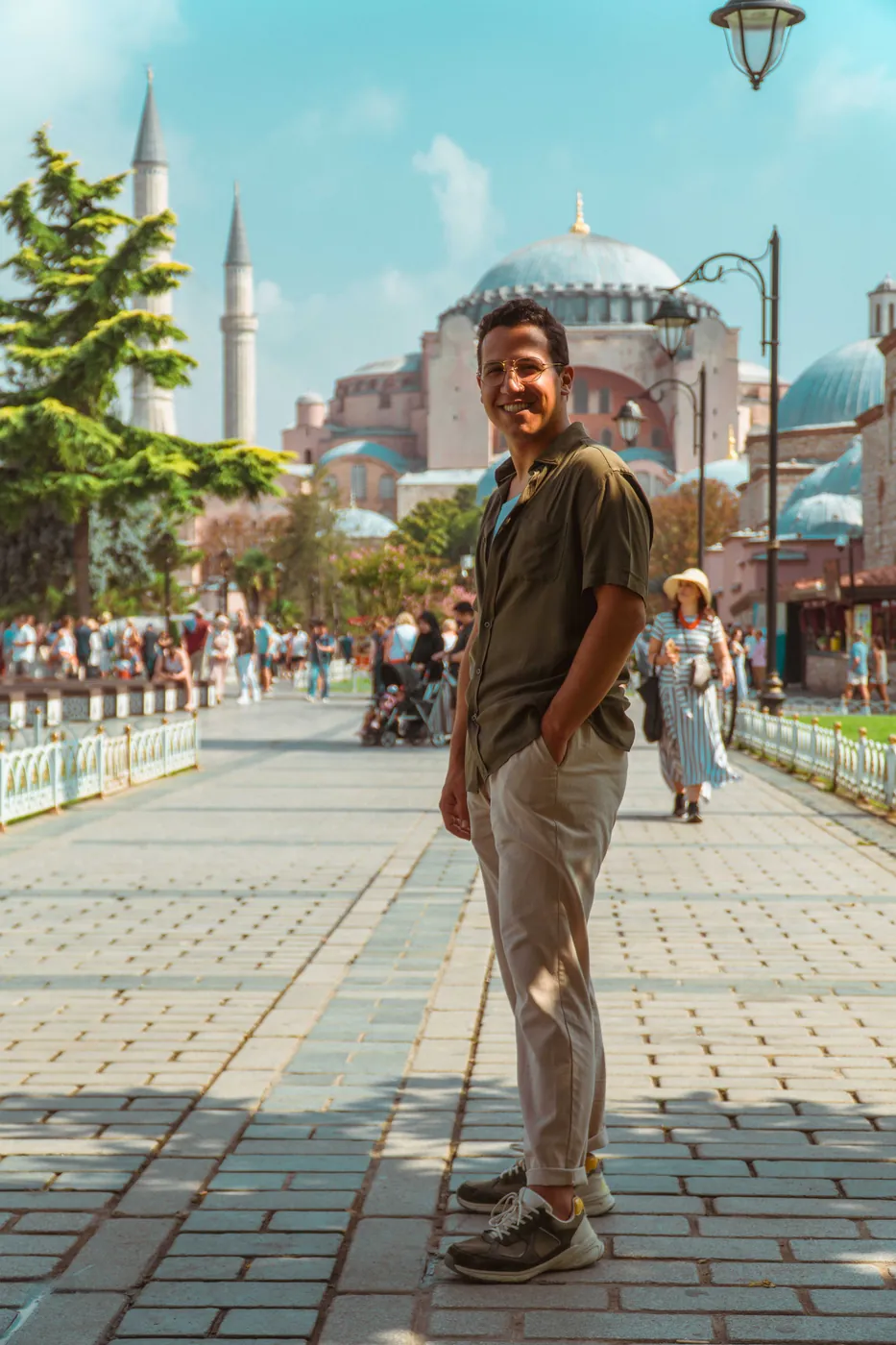
Istanbul is the city on two continents, Europe on one side of the Bosphorus and Asia on the other. It was the capital of the Byzantine and Ottoman empires, and it is full of mosques, palaces, bazaars and life. We landed late at night on 26 August 2022 and had one free day and one morning before the tour took us to Ankara.
Our free day was the best of the trip. Instead of the agency's optional tour, we followed our own plan around the old town.
Tip: To enter the mosques, cover your shoulders and knees. Women also need a scarf over their hair. Avoid prayer times.
Day 2 - Our own walk around the old town
1. Sultanahmet Square and the Blue Mosque
The Sultan Ahmet Mosque gets its nickname from the tens of thousands of blue Iznik tiles inside. It was built in the early 17th century to rival Hagia Sophia, right across the square, and it has six minarets.
The gardens between the Blue Mosque and Hagia Sophia are a joy, with the two domes facing each other, and they are even better at dusk with the call to prayer. Behind the mosque, the Arasta Bazaar has good-quality handicraft shops, and the Great Palace Mosaic Museum is hidden between the two.
2. The Hippodrome
The center of Byzantine public life, scene of chariot races and games, begun in the year 203 and finished by Constantine in 330. Little is left of the stands, but the square on its site still has the Egyptian Obelisk and the Serpent Column.
3. The Basilica Cistern
One of Istanbul's most surprising sights: a huge underground water reservoir with 336 ancient columns, many taken from older buildings and temples, which you explore on wooden walkways. In the far corner, two columns stand on the famous Medusa heads.
4. Hagia Sophia
Istanbul's most famous monument. It was built in the 6th century as a cathedral, the largest church in Christendom for almost a thousand years, then became a mosque, then a museum, and is a mosque again today. Its dome is still breathtaking.
5. Topkapı Palace
For almost 400 years the home of the Ottoman sultans, and now one of the richest museums in the world. Don't miss the Harem, where the sultan's family lived, the huge palace kitchens and the Imperial Council Chamber in the Second Court, and the Third Court, with the sultan's private rooms, the relics of the Prophet Muhammad and the Imperial Treasury, full of gold and precious stones.
6. Istanbul Archaeology Museums
Right next to Topkapı Palace, worth a stop if you like history.
7. The Grand Bazaar
One of the largest covered markets in the world, basically the world's first shopping mall: around 60 streets and thousands of shops selling jewelry, hand-painted ceramics, carpets, lamps, spices and antiques. Be ready to bargain.
8. Süleymaniye Mosque
Up on the hill above the Golden Horn, built for Suleiman the Magnificent by Sinan, the greatest Ottoman architect. It is one of the city's most recognizable landmarks, and the view from its gardens is wonderful.
9. Rüstem Paşa Mosque
A small mosque near the Spice Bazaar, perhaps the prettiest in Istanbul, with the best preserved Iznik tile panels in the city.
10. Fatih Mosque
Built on the site of the first imperial mosque of the city, by Mehmet the Conqueror, who took Constantinople in 1453 and is buried here. The original was destroyed by an earthquake and rebuilt in the 18th century.
11. Galata Tower
Across the Golden Horn, the round stone tower built by the Genoese in the 14th century. At 52 meters it was the tallest building in Istanbul for centuries, and it is still one of its symbols.
12. Dolmabahçe Palace
The lavish 19th-century palace on the Bosphorus where the last sultans moved from Topkapı, full of art, carvings and Bohemian crystal.
Sunset
End the day in Karaköy, by the water, or at Sanatkarlar Park, with a view over the Bosphorus.
Day 3 - Taksim, the Golden Horn and the Spice Bazaar
The next morning was with the tour:
- Taksim Square and Istiklal Avenue, the long pedestrian street of modern Istanbul, with the 19th-century church of St Anthony of Padua, cafés, shops and an old red tram. At the bottom end is the Tünel, one of the oldest underground railways in the world, from 1875.
- The Golden Horn and the Eyüp district.
- The Bulgarian St Stephen Church, made entirely of cast iron.
- The Spice Bazaar, also called the Egyptian Bazaar, from the 17th century, next to the New Mosque. The place to buy Turkish delight, dried fruit, nuts, tea and spices. Go before 11am or after 4pm to avoid the crowds.
In the afternoon the coach left Istanbul for Ankara.
If you have more time
- A boat trip on the Bosphorus, between Europe and Asia.
- The Chora Church (Kariye), with beautiful Byzantine mosaics and frescoes, a little far from the center.
- The Little Hagia Sophia, said to have been a test run for the big one.
- Yedikule Fortress, the Castle of the Seven Towers, by suburban train.
- The Museum of Innocence, created by the Nobel Prize-winning writer Orhan Pamuk, near Istiklal.
Comments
Comments couldn't load right now.